What Is Machine Learning? 🤖🧠🚀
Stop writing rules. Start teaching patterns. ML is when you show examples and let the algorithm figure out the rules itself!
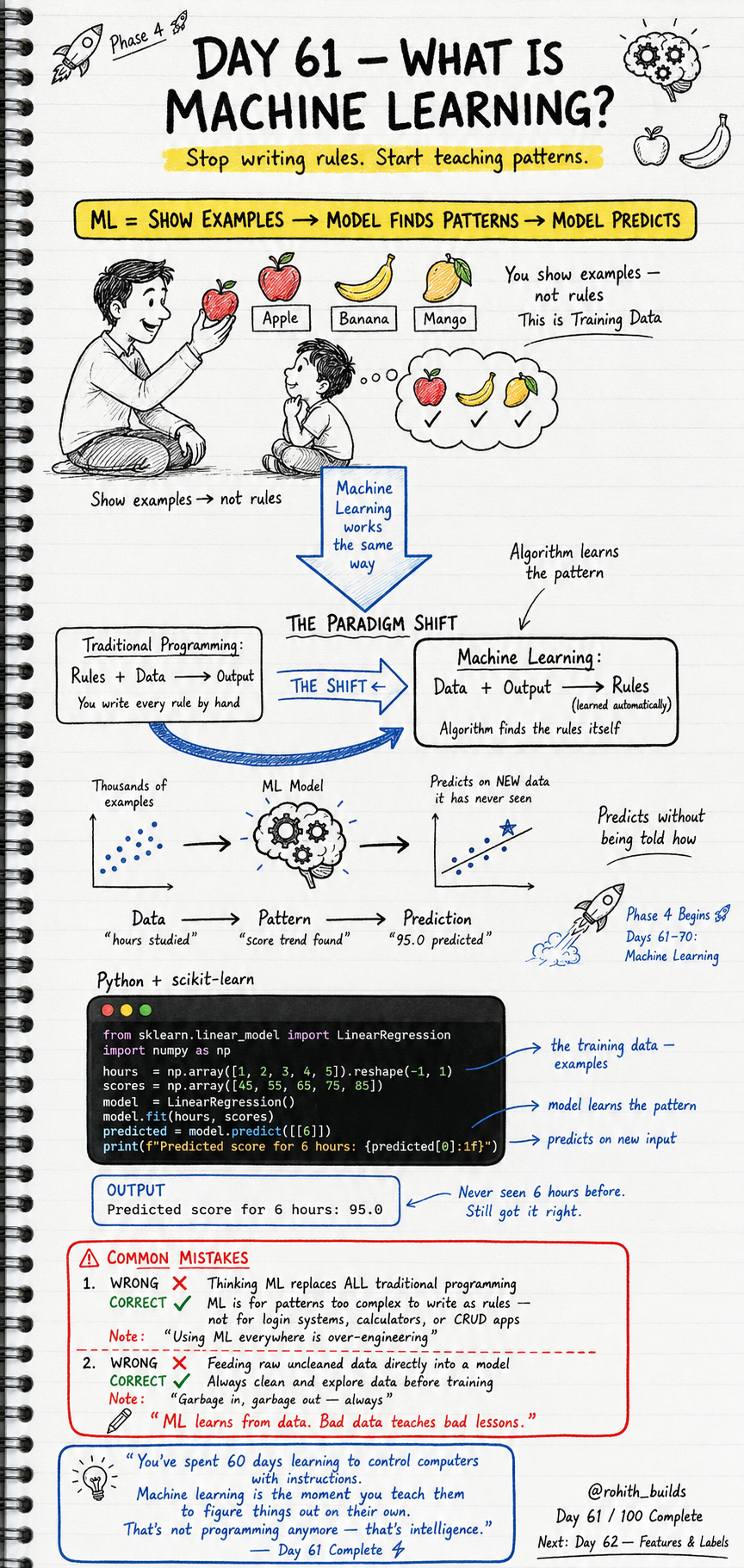
Day 61: What Is Machine Learning? — Teach the Computer to Think!
Why Should I Care?
You spent 60 days learning to control computers with instructions. Machine Learning is the moment you teach them to figure things out on their own. ChatGPT was not programmed with rules for every sentence — it learned patterns from billions of examples. YouTube does not have rules for every recommendation — it learned your taste from your history. That is not programming anymore. That is intelligence!
The Paradigm Shift
Traditional Programming: you write Rules plus feed Data and get Output. You manually code every rule by hand. Machine Learning: you feed Data plus known Output and the algorithm finds the Rules automatically. You stop writing rules. You show examples. The model figures out the pattern itself. Same goal, completely different approach!
Teaching Like a Parent
A parent teaching a child fruit names does not write rules like "if it is red and round it is an apple." They just show examples — Apple, Banana, Mango — again and again. The child learns the pattern. Machine Learning works exactly the same way. Show thousands of examples. The model learns the pattern. Then it predicts on new data it has never seen before!
Your First ML Model
from sklearn.linear_model import LinearRegression
import numpy as np

hours  = np.array([1, 2, 3, 4, 5]).reshape(-1, 1)
scores = np.array([45, 55, 65, 75, 85])

model = LinearRegression()
model.fit(hours, scores)

predicted = model.predict([[6]])
print(f"Predicted score for 6 hours: {predicted[0]:.1f}")
Output: Predicted score for 6 hours: 95.0. You never told the model the formula. You showed it 5 examples of hours and scores. model.fit() learned the pattern. model.predict() predicted a score for 6 hours — a value it had never seen before. Still got it right. That is machine learning!
The Three Steps of Every ML Model
Step 1 — Training Data: show the model thousands of examples. Hours studied and the resulting scores. This is where learning happens. Step 2 — Pattern Finding: model.fit() runs and the algorithm finds the relationship between hours and scores automatically. Step 3 — Prediction: model.predict() uses the learned pattern to predict on brand new input it has never seen before. Data, Pattern, Prediction — always in this order!
Real World Connection
Spotify was not programmed with rules for your taste. It learned from millions of listening examples. Gmail spam filter was not given rules for every spam email. It learned from millions of spam examples. When you apply for a loan, a bank ML model was trained on millions of past loan applications — approved and rejected — and now predicts your risk score. When Zomato predicts your delivery time, it learned from millions of past deliveries. ML is running silently behind every intelligent feature you use daily!
Common Mistakes
Mistake 1 — Thinking ML replaces all traditional programming.
ML is for patterns too complex to write as rules. Login systems, calculators and CRUD apps do not need ML — they need normal code. Using ML everywhere is massive over-engineering. Use ML only when the pattern is too complex to express as written rules!
Mistake 2 — Feeding raw uncleaned data into a model.
model.fit(raw_dirty_data, scores)   # WRONG — bad data teaches bad lessons!

# CORRECT — always clean and run EDA first!
df = df.dropna()
df["score"] = df["score"].astype(int)
model.fit(clean_data, scores)
Mini Challenge
Mini Challenge
Create training data — hours of practice and cricket runs scored for 5 players. Train a LinearRegression model on it. Predict the runs for a player who practised 7 hours. Print the prediction. Then ask yourself — did the model get a sensible answer? Does it match the trend? You just trained your first predictive model — the same type that powers every sports analytics platform in the world!
Quick Quiz
Q: What is the key difference between traditional programming and machine learning? A: Traditional programming needs rules written by hand. ML finds the rules automatically from examples!
Q: What does model.fit() do? A: It trains the model — the algorithm learns the pattern from your training data!
Q: Should you use ML for a login system or a calculator? A: Never! ML is for patterns too complex to write as rules. Use normal code for simple logic!
Key Takeaways
Key Takeaways
- ML = show examples, model finds patterns, model predicts on new data.
- Traditional programming writes rules. ML learns rules from data automatically.
- Three steps always: training data, model.fit() to learn, model.predict() to forecast.
- Always clean data before training — bad data teaches bad lessons.
- ML is not for everything — use it only when patterns are too complex to write by hand!
Continue Learning with Rohi
You've used your 3 free Rohi questions. Create a free account to continue learning.