AI Architecture 🏗️🤖🚀
Learn how to design a lean production-ready AI startup stack — build the simplest thing that ships today, design scale doors for tomorrow, and never over-engineer before your first user. Every choice reversible. Ship first.
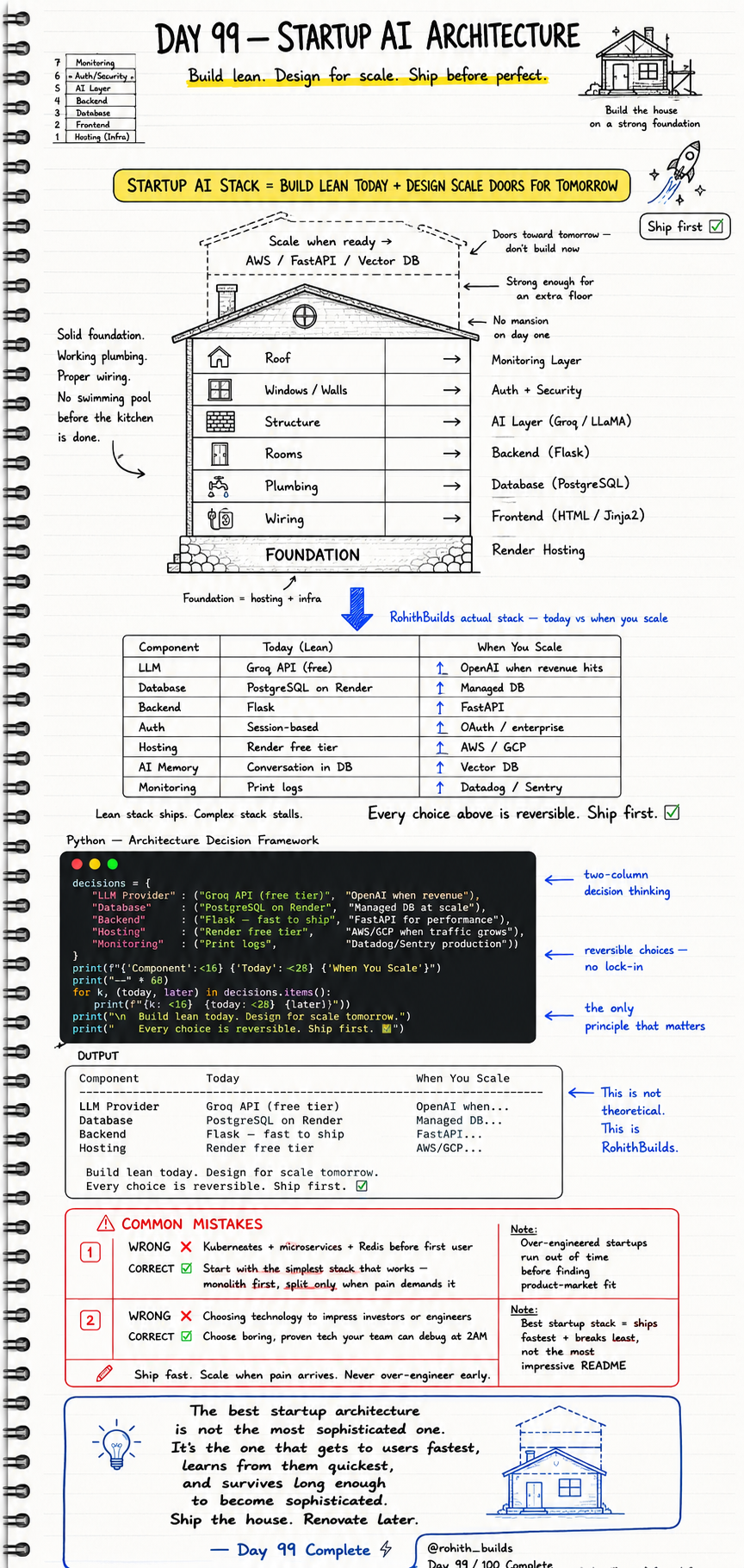
Day 99: Startup AI Architecture
Why Should I Care?
Most first-time builders kill their product before a single user touches it. They spend months picking the perfect database, debating microservices, and setting up Kubernetes — then run out of time and money before finding out if anyone even wants the thing. The best startup architecture is not the most sophisticated one. It is the one that gets to users fastest, learns from them quickest, and survives long enough to become sophisticated. Ship the house. Renovate later. That is the whole lesson.
Core Concept
A startup AI stack has two modes: what you build today and what you scale to tomorrow. Today you build lean — the simplest stack that works and ships. Tomorrow you scale — but only when real pain demands it, not before. The formula: Build lean today plus design scale doors for tomorrow equals a startup AI stack that actually survives. Every technology choice you make today must be reversible. No lock-in. No over-commitment. Ship first.
How It Works
Think of your architecture as a house. You build foundation first — hosting and infrastructure. Then wiring — your frontend with HTML and Jinja2. Then plumbing — your database with PostgreSQL. Then rooms — your backend with Flask. Then structure — your AI layer with Groq or LLaMA. Then windows and walls — auth and security. Then the roof — monitoring layer last, not first. Solid foundation. Working plumbing. Proper wiring. No swimming pool before the kitchen is done. Scale doors like AWS, FastAPI, and Vector DB sit on the roof — ready to add when traffic demands it. Not on day one.
Layer 7  Monitoring       --> print logs today, Datadog when scale
Layer 6  Auth/Security    --> session-based today, OAuth at scale
Layer 5  AI Layer         --> Groq API free tier today, OpenAI when revenue
Layer 4  Backend          --> Flask today, FastAPI at scale
Layer 3  Database         --> PostgreSQL on Render today, Managed DB at scale
Layer 2  Frontend         --> HTML / Jinja2 today
Layer 1  Hosting (Infra)  --> Render free tier today, AWS/GCP when traffic grows

Foundation = hosting + infra. Build this first. Always.
Real World Connection
This is the exact stack RohithBuilds runs on right now — not theoretical, not a textbook example. Groq API on the free tier for the LLM. PostgreSQL on Render for the database. Flask for the backend. HTML and Jinja2 for the frontend. Render free tier for hosting. Print logs for monitoring. Every single choice above is reversible. When revenue hits, swap Groq for OpenAI. When traffic grows, move to AWS. When performance hurts, switch Flask for FastAPI. Lean stack ships. Complex stack stalls. That is the only principle that matters on day one.
Examples
decisions = {
    "LLM Provider" : ("Groq API (free tier)",    "OpenAI when revenue"),
    "Database"     : ("PostgreSQL on Render",     "Managed DB at scale"),
    "Backend"      : ("Flask -- fast to ship",    "FastAPI for performance"),
    "Hosting"      : ("Render free tier",         "AWS/GCP when traffic grows"),
    "Monitoring"   : ("Print logs",               "Datadog/Sentry production")
}

print(f"{'Component':<16} {'Today':<28} {'When You Scale'}")
print("-" * 68)
for k, (today, later) in decisions.items():
    print(f"{k:<16} {today:<28} {later}")

print("\n Build lean today. Design for scale tomorrow.")
print("   Every choice is reversible. Ship first.")

# OUTPUT:
# Component        Today                        When You Scale
# LLM Provider     Groq API (free tier)         OpenAI when...
# Database         PostgreSQL on Render          Managed DB...
# Backend          Flask -- fast to ship         FastAPI...
# Hosting          Render free tier              AWS/GCP...
# Build lean today. Design for scale tomorrow.
# Every choice is reversible. Ship first.
Common Mistakes
Mistake 1 — Over-engineering before the first user:
-- WRONG:
Set up Kubernetes + microservices + Redis
before a single user has touched the product.

-- CORRECT:
Start with the simplest stack that works.
Monolith first. Split only when pain demands it.
Over-engineered startups run out of time before
finding product-market fit.
Mistake 2 — Choosing technology to impress instead of to ship:
-- WRONG:
Choose the most impressive tech stack for the README.
GraphQL + gRPC + Kafka on day one.

-- CORRECT:
Choose boring, proven tech your team can debug at 2AM.
The best startup stack ships fastest and breaks least --
not the one with the most impressive README.
Ship fast. Scale when pain arrives. Never over-engineer early.
Mini Challenge
Mini Challenge
Write your own architecture decision table for a project you want to build. Two columns: Today (lean) and When You Scale. Fill in LLM Provider, Database, Backend, Hosting, and Monitoring. For every row ask yourself: is this choice reversible? If yes, you are thinking like a builder. If any choice feels like a lock-in, swap it for the simpler option first. That table is your startup architecture. It fits in ten lines. Ship from it.
Quick Quiz
Q: What is the first layer to build in a startup AI architecture and why?
A: Hosting and infrastructure — the foundation. Without it nothing else runs. Every other layer sits on top of it, so it must be solid before anything else is added.
Q: Why should every technology choice in a lean stack be reversible?
A: Because you do not yet know what will hurt at scale. Reversible choices let you swap components as real pain arrives instead of being locked into decisions made before your first user.
Q: When should you split a monolith into microservices?
A: Only when the pain of staying monolithic is real and measurable — not before. Splitting too early adds complexity that kills velocity before product-market fit is found.
Bonus Knowledge
The scale doors in the architecture diagram are not things you build on day one. They are things you design space for. When you build with Flask, you structure your routes cleanly enough that swapping to FastAPI later takes days not months. When you use PostgreSQL, you write migrations properly so moving to a managed DB is a config change not a rewrite. That is what designing scale doors means. Not building them now. Building the house strong enough to add a floor later. Monitoring goes on the roof — last, not first. Print logs are enough until real users create real errors worth tracking. Two-column thinking — today versus when you scale — is the mental model every technical founder needs before writing a single line of code.
Key Takeaways
Key Takeaways
- A startup AI stack has two modes — what you build lean today and what you scale to when pain demands it.
- Build foundation first: hosting, then frontend, database, backend, AI layer, auth, monitoring — in that order.
- Every technology choice must be reversible — no lock-in before your first real user.
- Lean stack ships. Complex stack stalls. Choose boring, proven tech your team can debug at 2AM.
- Never add Kubernetes, microservices, or Redis before a single user has touched the product.
- Design scale doors — structure the code so upgrading components later takes days not months.
- The best startup architecture is the one that gets to users fastest and survives long enough to become sophisticated. Ship the house. Renovate later.
Continue Learning with Rohi
You've used your 3 free Rohi questions. Create a free account to continue learning.