AI Basics 🤖🧠🔺
Zoom out and understand the full AI landscape — from Narrow AI that exists today to General and Super AI on the horizon — and see exactly where everything you have built so far fits inside the bigger picture.
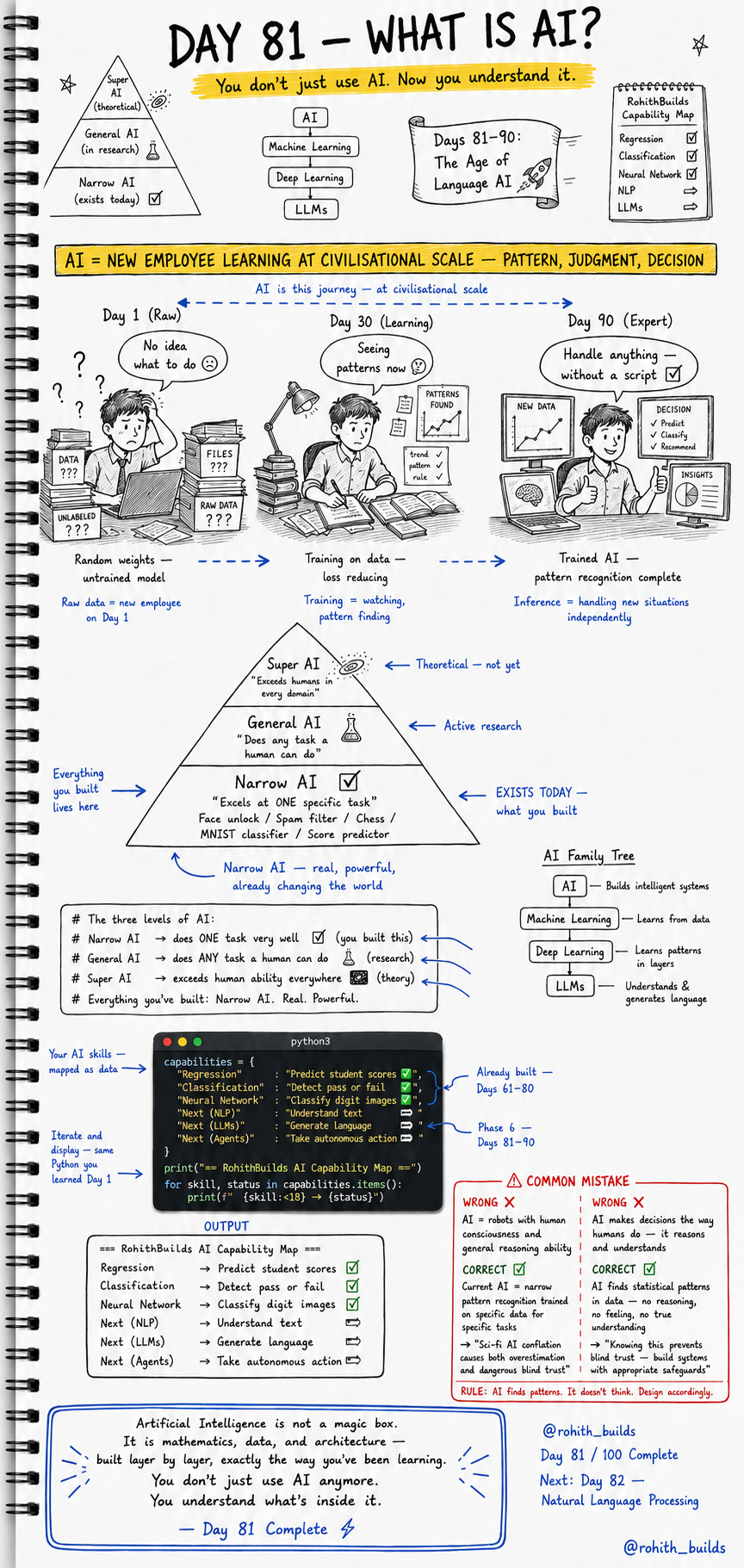
Day 81: What Is AI? — You Don''t Just Use It, You Understand It
Why Should I Care?
Everyone talks about AI. Almost nobody understands what it actually is. After 80 days of building real things — regression models, neural networks, image classifiers — you are not just a user anymore. Today you zoom out and see the entire map. Where does everything you built fit? What comes next? By the end of this lesson you will be able to explain AI to anyone, correctly, confidently, and without the hype.
Core Concept
AI is like a new employee learning at civilisational scale. On Day 1 they have no idea what to do — that is a model with random weights. By Day 30 they are seeing patterns and improving — that is training with loss reducing. By Day 90 they can handle anything independently without a script — that is a trained model doing inference on new data. AI is not magic. It is mathematics, data, and architecture — built layer by layer, exactly the way you have been learning.
How It Works
There are three levels of AI arranged in a pyramid. At the base is Narrow AI — this exists today and is what you have been building. It excels at one specific task. Face unlock, spam filters, chess engines, your MNIST classifier — all Narrow AI. In the middle is General AI — active research, not yet achieved — a system that can do any task a human can do. At the top is Super AI — theoretical, not yet real — a system that exceeds human ability in every domain. Everything you built lives at the powerful, world-changing base of that pyramid.
The three levels of AI:

Narrow AI   -->  Does ONE task very well        (EXISTS TODAY — you built this)
             Examples: face unlock, spam filter, chess,
                       MNIST classifier, score predictor

General AI  -->  Does ANY task a human can do   (Active research — not yet)

Super AI    -->  Exceeds human ability everywhere (Theory — not yet)

The AI Family Tree:

AI               -->  Builds intelligent systems
  Machine Learning -->  Learns from data
    Deep Learning  -->  Learns patterns in layers
      LLMs         -->  Understands and generates language

Days 61-80:  Regression, Classification, Neural Networks  (BUILT)
Days 81-90:  NLP, LLMs, Agents                           (COMING NEXT)
Real World Connection
Every AI feature you use daily is Narrow AI. Swiggy predicting your delivery time — Narrow AI. YouTube deciding which video plays next — Narrow AI. PhonePe detecting a fraudulent transaction in milliseconds — Narrow AI. Even ChatGPT, which feels incredibly broad and general, is technically a very capable Narrow AI — it was trained specifically on language. True General AI does not exist yet. Knowing this stops you from both over-trusting and under-trusting the AI tools you use every day.
Examples
# RohithBuilds AI Capability Map
# Your AI skills mapped as data — same Python from Day 1

capabilities = {
    "Regression"     : "Predict student scores",
    "Classification" : "Detect pass or fail",
    "Neural Network" : "Classify digit images",
    "Next (NLP)"     : "Understand text",
    "Next (LLMs)"    : "Generate language",
    "Next (Agents)"  : "Take autonomous action"
}

print("=== RohithBuilds AI Capability Map ===")
for skill, status in capabilities.items():
    print(f"  {skill:<18} -> {status}")

# OUTPUT:
# === RohithBuilds AI Capability Map ===
#   Regression         -> Predict student scores
#   Classification     -> Detect pass or fail
#   Neural Network     -> Classify digit images
#   Next (NLP)         -> Understand text
#   Next (LLMs)        -> Generate language
#   Next (Agents)      -> Take autonomous action
#
# Days 61-80: Built and working
# Days 81-90: Phase 6 — Language AI begins now
Common Mistakes
Two dangerous misconceptions about AI that even smart people get wrong. Both come from science fiction, not science. Getting these right makes you more trustworthy than most people talking about AI publicly.
-- MISTAKE 1: Thinking AI has consciousness or feelings --

WRONG:
  "AI = robots with human consciousness
   and general reasoning ability"

CORRECT:
  Current AI = narrow pattern recognition
  trained on specific data for specific tasks.
  No feelings. No awareness. No reasoning.

NOTE: "Sci-Fi AI conflation causes both
       overestimation and dangerous blind trust."


-- MISTAKE 2: Thinking AI reasons like a human --

WRONG:
  "AI makes decisions the way humans do —
   it reasons and understands"

CORRECT:
  AI finds statistical patterns in data.
  No reasoning. No feeling. No true understanding.
  It is a very powerful pattern-matching engine.

NOTE: "Knowing this prevents blind trust —
       build systems with appropriate safeguards."
RULE: AI finds patterns. It doesn''t think.
      Design accordingly.
Mini Challenge
Mini Challenge
Open a new Python file and extend the capabilities dictionary from the Examples section. Add three more AI applications you personally use — like Netflix recommendations, Google Maps traffic prediction, or Instagram feed ranking. For each one, label it as Narrow, General, or Super AI. Then print your extended map. Share it with one friend and explain to them in two sentences what Narrow AI actually is. Teaching it is the final proof that you understand it.
Quick Quiz
Q1: Which type of AI exists today and powers all the apps and models you have built? A1: Narrow AI — it excels at one specific task and is already changing the world at scale. Q2: Is ChatGPT an example of General AI? A2: No. Despite feeling very capable, ChatGPT is Narrow AI — trained specifically on language tasks, not a system that can do any task a human can. Q3: What is the correct way to describe how AI makes decisions? A3: AI finds statistical patterns in data — it does not reason, feel, or truly understand anything the way humans do.
Bonus Knowledge
The AI family tree has a clear hierarchy. AI is the broadest term — it means building systems that perform tasks intelligently. Machine Learning is a subset of AI where systems learn from data instead of being explicitly programmed with rules. Deep Learning is a subset of Machine Learning that uses neural networks with many layers to find complex patterns. LLMs — Large Language Models — are a subset of Deep Learning trained specifically to understand and generate human language. You have now climbed from the bottom of this tree all the way to the point where LLMs begin. Days 81 to 90 take you inside language AI.
Key Takeaways
Key Takeaways
- AI is not magic — it is mathematics, data, and architecture built layer by layer.
- Narrow AI exists today and powers every AI feature in every app you use — face unlock, spam filters, recommendations, classifiers.
- General AI is active research and does not yet exist — a system that can do any task a human can do.
- Super AI is theoretical — a system that exceeds human ability in every domain — and does not exist yet.
- AI finds statistical patterns in data — it does not reason, feel, or understand the way humans do.
- The AI family tree goes: AI, then Machine Learning, then Deep Learning, then LLMs — and you have climbed every level.
Continue Learning with Rohi
You've used your 3 free Rohi questions. Create a free account to continue learning.