Neurons ⚡🧠🔗
Understand how a single artificial neuron works — inputs multiplied by weights, plus a bias, checked against a threshold — and why this tiny decision unit powers every AI system in the world.
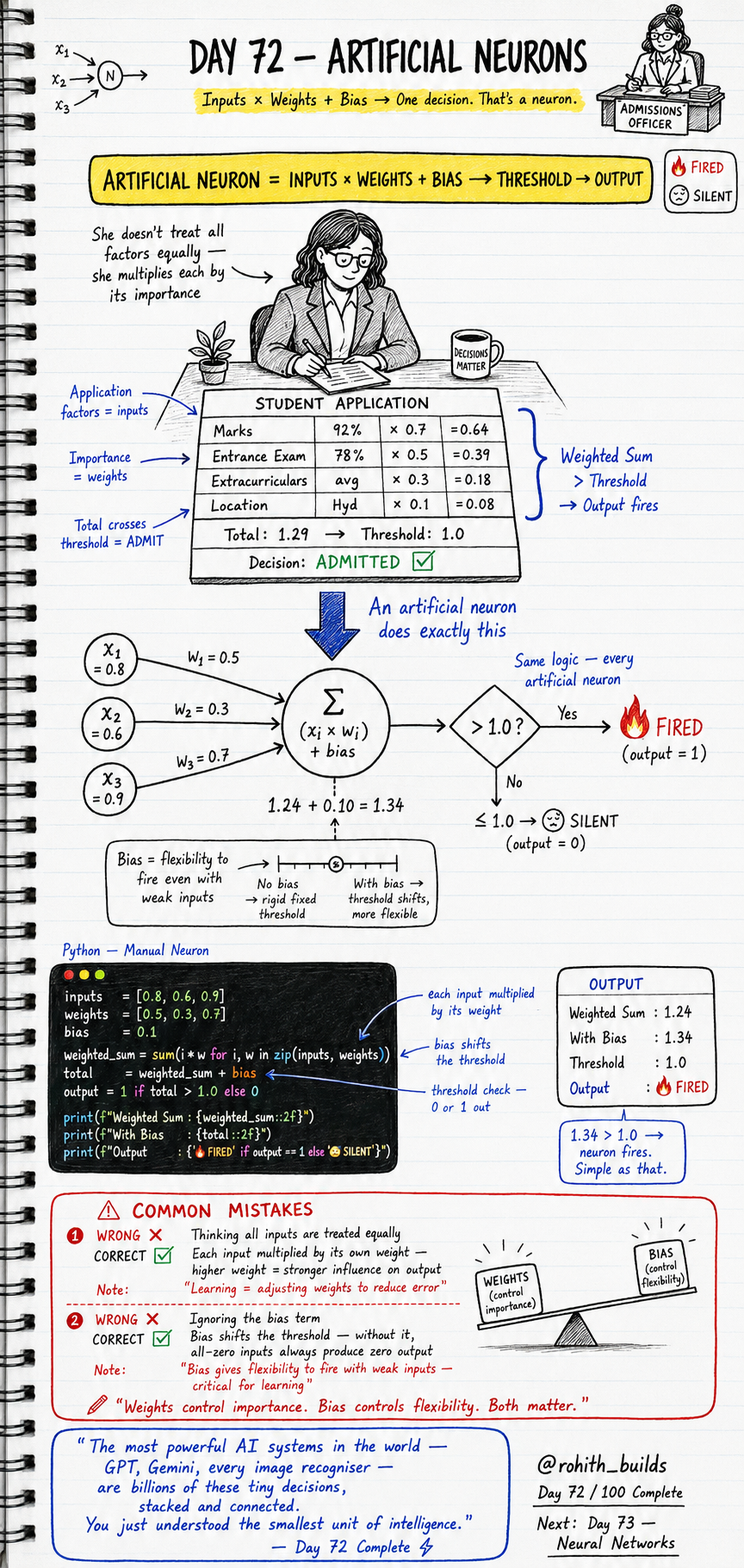
Day 72: Artificial Neurons
Why Should I Care?
GPT, Gemini, the face unlock on your phone, the spam filter in your Gmail — all of them are made of billions of tiny decisions. Each tiny decision is made by one artificial neuron. If you understand one neuron, you understand the building block of every AI system ever built. That is what today is about.
Core Concept
An artificial neuron does one job: take some inputs, multiply each by its importance, add a small flexibility number, and decide — fire or stay silent. The formula is simple: Inputs times Weights, plus Bias, checked against a Threshold. If the total crosses the threshold, the neuron fires and outputs 1. If not, it stays silent and outputs 0. That is it. One decision. Billions of these stacked together become intelligence.
How It Works
Think of a college admissions officer. She looks at your application — marks, entrance exam score, extracurriculars, location. She does not treat all factors equally. Marks get more importance than location. She multiplies each factor by its importance weight, adds them up, and if the total crosses her threshold — you are admitted. An artificial neuron does exactly this. Inputs are your application factors. Weights are the importance she gives each one. Bias is her flexibility — it shifts the threshold so she can still admit someone even if one factor is weak. If the weighted sum plus bias crosses 1.0 — the neuron fires. Output is 1. Decision made.
Student Application Example:
Marks          92%  x  0.7  =  0.64
Entrance Exam  78%  x  0.5  =  0.39
Extracurriculars avg x 0.3  =  0.18
Location       Hyd  x  0.1  =  0.08

Total = 1.29   Threshold = 1.0
Decision: ADMITTED (neuron fired)
Real World Connection
Every time Zomato decides whether to show you a restaurant recommendation — a neuron fires or stays silent. Every time PhonePe decides if a transaction looks suspicious — neurons fire together to raise a flag. Every time YouTube decides your next recommended video — millions of neurons vote with 1s and 0s. The whole app is just neurons stacked in layers, each one making one tiny decision at lightning speed.
Examples
inputs  = [0.8, 0.6, 0.9]
weights = [0.5, 0.3, 0.7]
bias    = 0.1

weighted_sum = sum(i * w for i, w in zip(inputs, weights))
total        = weighted_sum + bias
output       = 1 if total > 1.0 else 0

print(f"Weighted Sum : {weighted_sum:.2f}")
print(f"With Bias    : {total:.2f}")
print(f"Output       : {'FIRED' if output == 1 else 'SILENT'}")

# OUTPUT:
# Weighted Sum : 1.24
# With Bias    : 1.34
# Output       : FIRED
# 1.34 > 1.0 -- neuron fires. Simple as that.
Common Mistakes
Mistake 1 — Thinking all inputs are treated equally:
-- WRONG:
output = sum(inputs)   # treating all inputs the same

-- CORRECT:
weighted_sum = sum(i * w for i, w in zip(inputs, weights))
# higher weight = stronger influence on output
# learning means adjusting weights to reduce error
Mistake 2 — Ignoring the bias term:
-- WRONG:
total = weighted_sum   # no bias added

-- CORRECT:
total = weighted_sum + bias
# without bias, all-zero inputs always produce zero output
# bias gives flexibility to fire even with weak inputs
# bias is critical for learning
Mini Challenge
Mini Challenge
Open Google Colab. Copy the neuron code from the Examples section. Change the inputs to [0.2, 0.1, 0.3] and keep the same weights and bias. Run it. Does the neuron fire or stay silent? Now increase the bias to 0.9 and run again. What changed? You just saw how bias controls the flexibility of a neuron. That is the lesson in your hands.
Quick Quiz
Q: What is the role of weights in an artificial neuron?
A: Weights control the importance of each input. A higher weight means that input has a stronger influence on the final decision.
Q: What does bias do inside a neuron?
A: Bias shifts the threshold, giving the neuron flexibility to fire even when inputs are weak. Without bias, all-zero inputs always produce zero output.
Q: When does a neuron output 1 instead of 0?
A: When the weighted sum of inputs plus the bias crosses the threshold — in our example, when the total is greater than 1.0.
Bonus Knowledge
In real neural networks, weights are not set by hand. The network starts with random weights and adjusts them slowly using a process called backpropagation — learning from its own mistakes. The bias is also learned the same way. Both weights and bias are just numbers the network tunes over thousands of training rounds until it gets good at its job. Weights control importance. Bias controls flexibility. Both matter. Remember that line.
Key Takeaways
Key Takeaways
- An artificial neuron takes inputs, multiplies each by a weight, adds a bias, and fires or stays silent.
- Weights control how important each input is — higher weight means more influence.
- Bias gives the neuron flexibility — it shifts the threshold so weak inputs can still trigger a fire.
- If weighted sum plus bias crosses the threshold, output is 1 (fired). Otherwise output is 0 (silent).
- Learning means the network adjusts weights and bias to reduce errors over time.
- Every AI system in the world — GPT, Gemini, image recognition — is billions of these tiny neurons stacked and connected.
- You just understood the smallest unit of intelligence.
Continue Learning with Rohi
You've used your 3 free Rohi questions. Create a free account to continue learning.