Deep Learning 🤖🧠🚀
Learn how deep learning uses stacked layers to automatically find patterns in raw data — no rules written by hand — and build your first neural network with TensorFlow and Keras.
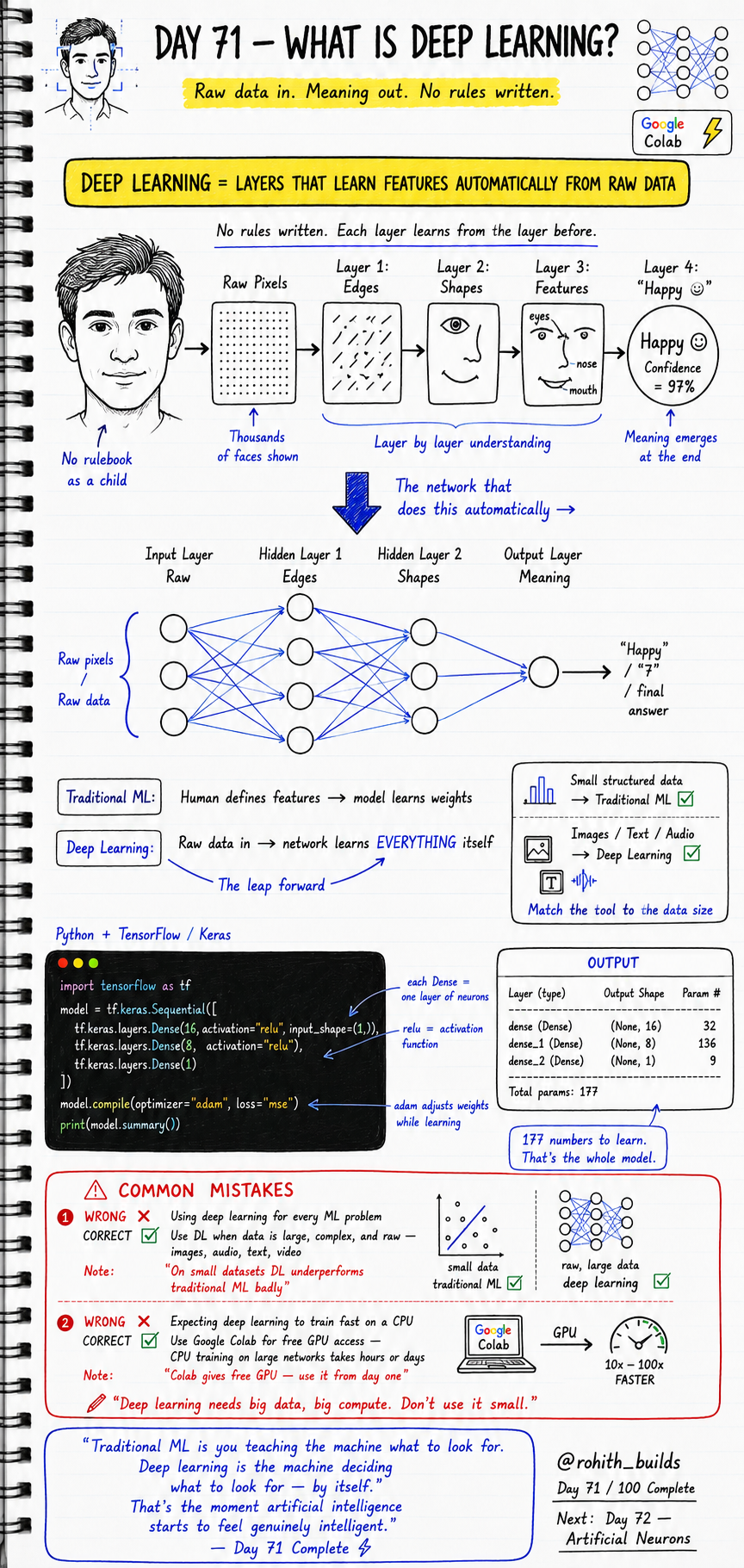
Day 71: What Is Deep Learning?
Why Should I Care?
Instagram knows your face. YouTube recommends the exact video you want. Snapchat filters turn you into a dog. All of that is deep learning doing its thing. No one wrote rules like "nose is here" or "eye is there." The machine figured it all out by itself. That is the magic of deep learning.
Core Concept
Deep Learning means building a network of layers that each learn something small — and together they learn something big. Raw data goes in. Meaning comes out. No rulebook. No hand-written features. The network learns everything on its own. Think of it like this: you learned to recognize faces as a kid. Nobody gave you a checklist. You just saw thousands of faces and your brain figured it out. Deep learning does the exact same thing.
How It Works
Imagine a photo of a face going through 4 stages inside the network: Layer 1 sees raw pixels and detects edges. Layer 2 combines edges into shapes like eyes and noses. Layer 3 combines shapes into facial features. Layer 4 looks at all features and says "Happy — 97% confident." Each layer passes its learning to the next. No rules written. Each layer learns from the layer before it. This is called a Neural Network — and deep learning is just a neural network with many hidden layers stacked together.
Input Layer (Raw)
     |
Hidden Layer 1 (Edges)
     |
Hidden Layer 2 (Shapes)
     |
Output Layer (Meaning: "Happy" / "7" / final answer)
Real World Connection
Every time Zomato shows you food photos and recommends dishes you like — deep learning. Every time Google Photos groups your family photos by face — deep learning. Every time Netflix auto-plays something you actually want to watch — deep learning. These apps deal with images, audio, and video. That is exactly where deep learning wins. Traditional ML struggles with raw images and audio. Deep learning eats them for breakfast.
Examples
import tensorflow as tf

model = tf.keras.Sequential([
    tf.keras.layers.Dense(16, activation="relu", input_shape=(1,)),
    tf.keras.layers.Dense(8,  activation="relu"),
    tf.keras.layers.Dense(1)
])

model.compile(optimizer="adam", loss="mse")
print(model.summary())

# OUTPUT:
# dense   (Dense)   -> (None, 16)  -> 32 params
# dense_1 (Dense)   -> (None,  8)  -> 136 params
# dense_2 (Dense)   -> (None,  1)  -> 9 params
# Total params: 177
# That means 177 numbers the model will learn on its own.
Each Dense layer is one layer of neurons. The activation "relu" helps the network learn non-linear patterns. The optimizer "adam" adjusts weights while learning. Just 177 numbers — and that is the whole tiny model.
Common Mistakes
Mistake 1 — Using deep learning for every problem:
-- WRONG:
Use deep learning on a small table of 200 rows with 5 columns.

-- CORRECT:
Use deep learning when data is large and complex —
images, audio, text, video.
On small datasets, deep learning underperforms traditional ML badly.
Mistake 2 — Training deep learning on a CPU and expecting it to be fast:
-- WRONG:
Train a deep learning model on your laptop CPU.
It will take hours or days on large networks.

-- CORRECT:
Use Google Colab for free GPU access.
GPU is 10x to 100x faster than CPU for deep learning.
Colab gives you a free GPU — use it from day one.
Mini Challenge
Mini Challenge
Open Google Colab. Copy the model code from the Examples section above. Run it. Read the model summary output. Answer this: how many total parameters does your model have? Change the first Dense layer from 16 neurons to 32 neurons and run again. Did the param count go up? That is your first hands-on neural network. Good work.
Quick Quiz
Q: What does each layer in a deep learning network learn?
A: Each layer learns small features from the layer before it — edges, then shapes, then full features — until meaning comes out at the end.
Q: When should you use deep learning instead of traditional ML?
A: When your data is large and complex — like images, audio, text, or video. For small structured tables, traditional ML works better.
Q: What does the optimizer "adam" do in a neural network?
A: Adam adjusts the weights of the network while it is learning — it is the engine that makes the model get smarter with each step.
Bonus Knowledge
Traditional ML: you define the features, the model learns the weights. Deep Learning: you give raw data, and the network learns the features AND the weights — everything. That leap is what makes deep learning feel like real intelligence. The tool to match: small structured data goes to traditional ML. Images, text, audio, video go to deep learning. Always match the tool to the size and type of your data.
Key Takeaways
Key Takeaways
- Deep learning uses stacked layers that each learn small features automatically from raw data.
- No rules are written by hand — the network figures out everything on its own.
- Traditional ML needs human-defined features. Deep learning discovers features by itself.
- Use deep learning for images, audio, text, and video — not for small structured tables.
- TensorFlow and Keras make it easy to build a neural network in just a few lines of Python.
- Always use Google Colab for free GPU access — CPU training is too slow for real models.
- 177 parameters in a tiny model. Real models have millions. But the idea is exactly the same.
Continue Learning with Rohi
You've used your 3 free Rohi questions. Create a free account to continue learning.