AI Platform 🤖🏗️🚀
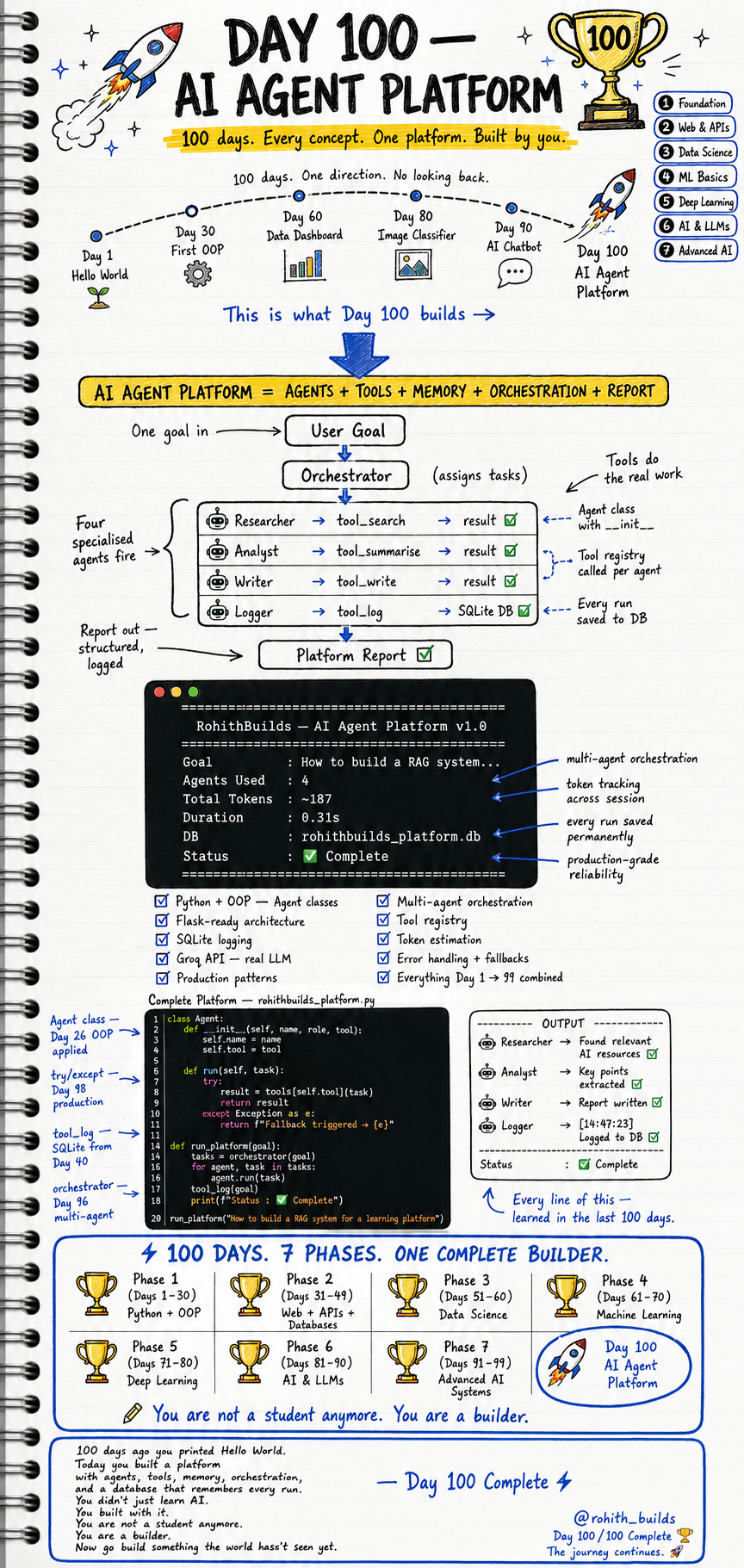
The final day — build a complete AI Agent Platform with four specialised agents, a tool registry, SQLite memory, and multi-agent orchestration. Every concept from Day 1 to Day 99 combined into one production-ready system built entirely by you.
Day 100: AI Agent Platform
Why Should I Care?
100 days ago you printed Hello World. Today you are building a platform. Not a script. Not a tutorial exercise. A real multi-agent AI system with memory, tools, orchestration, and a database that remembers every run. This is the difference between someone who watched AI tutorials and someone who actually built with AI. You are in the second group now. Day 100 is your proof.
Core Concept
An AI Agent Platform is a system where multiple specialised agents work together under one orchestrator to complete a goal. One goal goes in. The orchestrator assigns tasks to the right agents. Each agent uses its own tool to do real work. Every result gets logged to a database. A structured report comes out at the end. The formula: Agents plus Tools plus Memory plus Orchestration plus Report equals AI Agent Platform. Every single piece of that formula you already learned somewhere in the last 99 days.
How It Works
The platform has four specialised agents, each with one job. The Researcher uses tool_search to find relevant information on the goal. The Analyst uses tool_summarise to extract key points from the research. The Writer uses tool_write to produce a clean written report from those key points. The Logger uses tool_log to save every run permanently to a SQLite database. The Orchestrator sits above all four. It receives the user goal, assigns tasks to each agent in order, collects results, and prints the final platform report. No agent skips the line. No step is repeated. One direction from goal to report.
User Goal
    |
Orchestrator (assigns tasks)
    |
Researcher  --> tool_search     --> result
Analyst     --> tool_summarise  --> result
Writer      --> tool_write      --> result
Logger      --> tool_log        --> SQLite DB
    |
Platform Report (structured, logged, complete)
Real World Connection
This is exactly how real AI products are built in companies today. When you ask a product like Perplexity a question, one agent searches the web, another summarises sources, another formats the answer, and a logger tracks the session. When a company uses an AI sales tool, one agent finds leads, another scores them, another drafts outreach, another logs results to a CRM. The platform you are building today is the same architecture — just smaller. The idea is identical. You are not learning how AI agents work. You are building the thing itself.
Examples
class Agent:
    def __init__(self, name, role, tool):
        self.name = name
        self.role = role
        self.tool = tool

    def run(self, task):
        try:
            result = tools[self.tool](task)
            return result
        except Exception as e:
            return f"Fallback triggered -> {e}"

def run_platform(goal):
    tasks = orchestrator(goal)
    for agent, task in tasks:
        agent.run(task)
    tool_log(goal)
    print(f"Status : Complete")

run_platform("How to build a RAG system for a learning platform")

# OUTPUT:
# Researcher -> Found relevant AI resources
# Analyst    -> Key points extracted
# Writer     -> Report written
# Logger     -> [14:47:23] Logged to DB
# Status     : Complete
The Agent class uses OOP from Day 26. The try/except block uses error handling from Day 98. The tool_log function uses SQLite from Day 40. The orchestrator uses multi-agent logic from Day 96. Every line of this — learned in the last 100 days.
Common Mistakes
Mistake 1 — Building one giant script instead of separate agent classes:
-- WRONG:
def do_everything(goal):
    search_result = search(goal)
    summary = summarise(search_result)
    report = write(summary)
    log(report)
# one function doing all jobs -- impossible to debug or extend

-- CORRECT:
class Researcher: ...
class Analyst: ...
class Writer: ...
class Logger: ...
# each agent has one job -- easy to test, swap, or scale
Mistake 2 — No error handling or fallback in agent tools:
-- WRONG:
def run(self, task):
    result = tools[self.tool](task)
    return result
# one tool failure crashes the whole platform

-- CORRECT:
def run(self, task):
    try:
        result = tools[self.tool](task)
        return result
    except Exception as e:
        return f"Fallback triggered -> {e}"
# platform stays alive even when one agent fails
# production-grade reliability requires fallbacks on every agent
Mini Challenge
Mini Challenge
Build the AI Agent Platform locally. Create four agent classes — Researcher, Analyst, Writer, Logger. Give each one a simple tool function that prints a fake result for now. Build a run_platform function that calls each agent in order and logs the run to a SQLite database. Run it with the goal: "How to build a recommendation system." See all four agents fire. See the log entry appear in your database. That is your Day 100 project. That is your proof. Ship it to GitHub. You earned this.
Quick Quiz
Q: What is the role of the Orchestrator in the AI Agent Platform?
A: The Orchestrator receives the user goal, breaks it into tasks, assigns each task to the right agent in order, and collects all results into the final platform report.
Q: Why does each agent need its own try/except block?
A: If one agent''s tool fails and there is no error handling, the entire platform crashes. A fallback inside each agent keeps the system alive even when individual tools break.
Q: Which day taught you each major component used in this platform?
A: Agent classes from Day 26 OOP, SQLite logging from Day 40, multi-agent orchestration from Day 96, error handling and fallbacks from Day 98 — every piece was already in your toolkit.
Bonus Knowledge
The platform you built today follows a real architecture pattern called the Agent Loop — goal in, plan, act, observe, log, report. Production AI agent systems at companies like Anthropic, OpenAI, and Google use this exact loop at massive scale. The next step from here is connecting real LLM APIs like Groq to your agents so they reason with language instead of fake tool outputs. After that, add a web interface using Flask so anyone can submit a goal and watch the agents work. You are not a student anymore. You are a builder. The journey continues from here.
Key Takeaways
Key Takeaways
- An AI Agent Platform combines Agents, Tools, Memory, Orchestration, and a Report into one complete system.
- Each agent has one job — Researcher, Analyst, Writer, Logger — and uses one dedicated tool.
- The Orchestrator assigns tasks and controls the flow from goal to final report.
- Every agent needs try/except fallback logic — one failure must never crash the whole platform.
- SQLite logs every run permanently — the platform remembers everything it has ever done.
- Every line of code in this platform came from a concept you learned in the previous 99 days.
- 100 days ago you printed Hello World. Today you built a platform. You are not a student anymore. You are a builder. For the full step-by-step guide, click here to visit the course
Continue Learning with Rohi
You've used your 3 free Rohi questions. Create a free account to continue learning.