Loss Functions 🎯📉🏹
Discover how loss functions act as an AI model's coach by measuring exactly how wrong each prediction is, and learn the three key types — MSE, MAE, and BCE — so your model can improve with every shot.
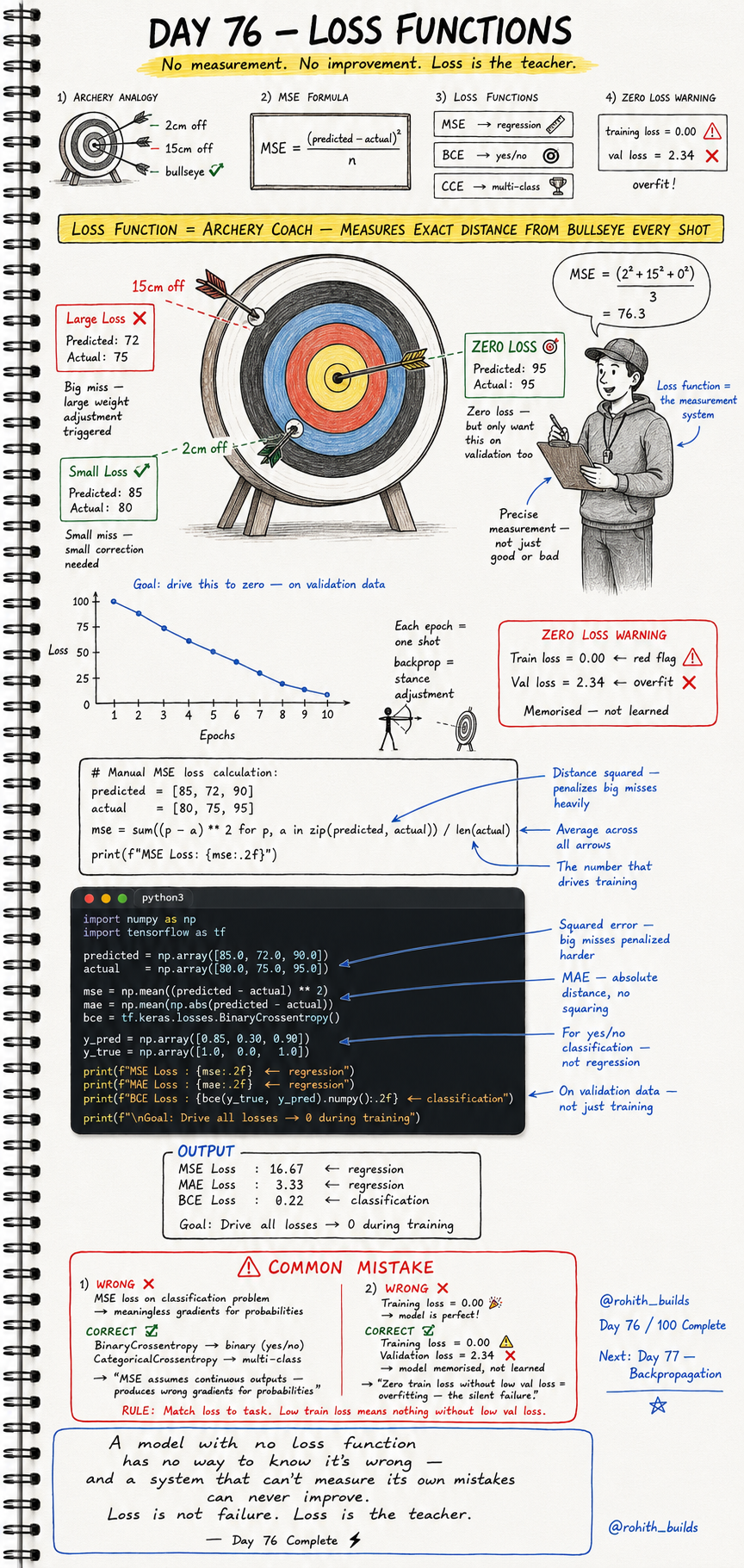
Day 76: Loss Functions — How AI Knows It is Wrong
Why Should I Care?
Imagine playing PUBG with zero feedback — no damage numbers, no kill feed, nothing. You would never know if your shots were landing. That is exactly what training an AI without a loss function looks like. The loss function tells the model how wrong it is so it can fix itself. No measurement means no improvement.
Core Concept
A loss function is like an archery coach. After every shot, the coach measures the exact distance between where your arrow landed and the bullseye. A big miss gets a big penalty. A small miss gets a small penalty. A perfect shot gets zero. The AI uses this score to adjust itself and shoot better next time. That score is called the loss.
How It Works
Every time the model makes a prediction, the loss function compares it to the correct answer and produces a single number — the loss. During training, the goal is to drive that number as close to zero as possible. Each training round is called an epoch. Think of it as one full round of archery practice. After each epoch, the model adjusts its aim using a process called backpropagation. There are three main loss functions to know.
MSE  (Mean Squared Error)     -->  Use for regression problems
                                   Example: predicting house prices

MAE  (Mean Absolute Error)    -->  Use for regression, less sensitive to outliers
                                   Example: predicting delivery time on Swiggy

BCE  (Binary Cross Entropy)   -->  Use for yes/no classification
                                   Example: spam or not spam, fraud or not fraud

CCE  (Categorical Cross Entropy) --> Use for multi-class classification
                                   Example: cat vs dog vs bird

MSE Formula:
MSE = (predicted - actual)^2 / n
Squaring the error penalises big misses much harder than small ones.
Real World Connection
Think about Zomato predicting your delivery time. It says 30 minutes but it actually takes 45 minutes — that is a 15-minute miss. The loss function squares that error and flags it as a big penalty. Next time the model trains, it corrects itself. Over thousands of orders, the predictions get tighter and tighter. That is loss-driven learning happening every single day inside apps you use.
Examples
# Manual MSE calculation
predicted = [85, 72, 90]
actual    = [80, 75, 95]

mse = sum((p - a) ** 2 for p, a in zip(predicted, actual)) / len(actual)
print(f"MSE Loss: {mse:.2f}")

# Output: MSE Loss: 16.67
# Arrow distances squared and averaged — big misses hurt way more


# Using NumPy and TensorFlow
import numpy as np
import tensorflow as tf

predicted = np.array([85.0, 72.0, 90.0])
actual    = np.array([80.0, 75.0, 95.0])

mse = np.mean((predicted - actual) ** 2)
mae = np.mean(np.abs(predicted - actual))
bce = tf.keras.losses.BinaryCrossentropy()

y_pred = np.array([0.85, 0.30, 0.90])
y_true = np.array([1.0,  0.0,  1.0])

print(f"MSE Loss : {mse:.2f}  <-- regression")
print(f"MAE Loss : {mae:.2f}  <-- regression")
print(f"BCE Loss : {bce(y_true, y_pred).numpy():.2f}  <-- classification")

# OUTPUT:
# MSE Loss :  16.67  <-- regression
# MAE Loss :   3.33  <-- regression
# BCE Loss :   0.22  <-- classification
# Goal: Drive all losses to 0 during training
Common Mistakes
Two classic mistakes that beginners make. First, using the wrong loss function for the task. Second, celebrating when training loss hits zero — that is actually a danger sign, not a victory.
-- MISTAKE 1: Wrong loss function for the task --

WRONG:
  Using MSE loss on a classification problem
  Result: meaningless gradients for probabilities

CORRECT:
  Binary classification (yes/no)  -->  BinaryCrossentropy
  Multi-class classification       -->  CategoricalCrossentropy

NOTE: "MSE assumes continuous outputs —
       it produces wrong gradients for probabilities."
RULE: Match the loss to the task always.


-- MISTAKE 2: Celebrating zero training loss --

WRONG:
  Training loss = 0.00
  Thinking: "My model is perfect!"

CORRECT:
  Training loss = 0.00  -->  Red flag
  Validation loss = 2.34  -->  Overfitting confirmed

NOTE: "Zero train loss without low val loss =
       overfitting — the silent failure."
      The model memorised the data, it did not learn.
Mini Challenge
Mini Challenge
Write a Python function called calculate_mse that takes two lists — predicted and actual — and returns the MSE loss. Test it with predicted = [10, 20, 30] and actual = [12, 18, 35]. Print the result and check if you get 9.67. Then try swapping to MAE by removing the squaring. See how the scores change and think about which one punishes big misses more.
Quick Quiz
Q1: What does a loss function measure? A1: The difference between the model''s prediction and the correct answer — how wrong the model is. Q2: Which loss function should you use for a yes or no classification problem like detecting spam? A2: Binary Cross Entropy (BCE). Q3: If your training loss is 0.00 but your validation loss is 2.34, what has happened? A3: The model has overfit — it memorised the training data but failed to learn patterns that generalise.
Bonus Knowledge
MSE squares the errors, which means one giant mistake can dominate the entire loss score. MAE uses absolute values instead, so every error is treated more equally. In real projects like predicting Netflix watch time or Amazon delivery estimates, data scientists choose between MSE and MAE based on how much they care about outliers. If one very wrong prediction is catastrophic, use MSE to punish it hard. If outliers are just noise, MAE keeps things calmer and more stable.
Key Takeaways
Key Takeaways
- A loss function measures exactly how wrong the model''s prediction is — like an archery coach measuring distance from the bullseye.
- The goal during training is to drive the loss as close to zero as possible on both training and validation data.
- MSE and MAE are used for regression tasks like predicting prices or delivery times.
- BCE is used for binary yes/no classification and CCE is used for multi-class problems.
- Zero training loss is a red flag — if validation loss is still high, the model has memorised, not learned.
- Always match your loss function to your task — using the wrong one gives the model the wrong signal entirely.
Continue Learning with Rohi
You've used your 3 free Rohi questions. Create a free account to continue learning.